
Carotid Disease
Table Of Contents
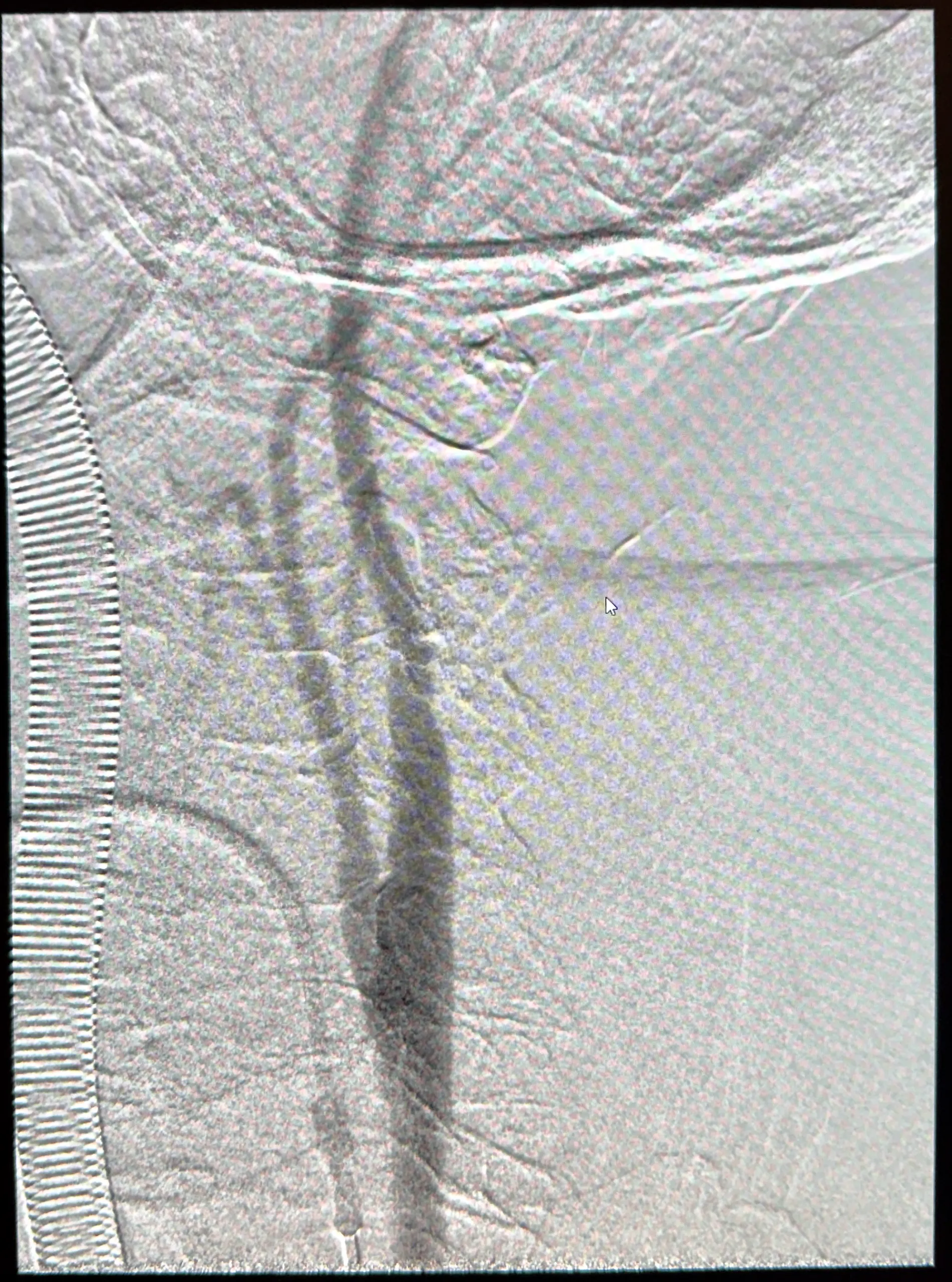
Calcification of the carotid artery as a cause of stroke
Every year, approximately 25,000 people in Austria suffer a stroke. This represents the third leading cause of death. Despite all the possibilities of modern medicine, lasting damage up to complete disability often remains.
Carotid artery stenosis can lead to a stroke in two ways. On the one hand, through extreme narrowing of the artery, which restricts blood flow to the brain so severely that brain cells receive insufficient oxygen and die.
On the other hand, a piece of plaque (= material that deposits on the inner wall of the artery and causes the narrowing) can break off and be carried into the brain as a so-called embolism.
It is assumed that this second mechanism (the detached embolism) is the significantly more common cause of stroke. The vascular surgical removal of carotid artery stenosis is scientifically proven to be the most effective form of stroke prevention.
Carotid surgery not only corrects the narrowing but also removes all plaque material, preventing any further embolizations.
Symptoms
Typical signs include sudden onset of functional deficits and one-sided changes—depending on which area of the brain is affected. The symptoms are often temporary, but they serve as crucial warning signs of a major stroke.
- Sudden feeling of weakness, paralysis, or numbness on one side of the body
- Visual disturbances such as loss of vision in half of the visual field, double vision, blurred vision, or loss of sight in one eye
- Speech difficulties or problems with speech comprehension (aphasia)
- Sudden dizziness with unsteady gait
- Severe headaches, nausea, and vomiting
Therapeutic options
The goal of treatment for a high-grade narrowing of the carotid artery (carotid stenosis) is to prevent a stroke or to achieve the best possible rehabilitation if a stroke has already occurred.
Conservative Therapy: Conservative therapy with medication is acceptable as long as the narrowing in the carotid artery does not significantly obstruct blood flow, and the surface of the plaque is smooth so that there is no risk of embolism.
Endovascular Stent Therapy: Stent therapy has only been adopted with limitations in carotid artery disease. The main argument against routine stenting is the higher neurological risk.
Intracranial Thrombectomy: A blood clot stuck in the arteries inside the skull can, in some cases, be retrieved using a catheter. This procedure is performed by neuroradiologists.
Intravenous Thrombolysis Therapy: During thrombolysis, a fresh clot is dissolved using medication. In the event of an acute stroke, there is only a short optimal time window of 4.5 hours. Old or calcified plaques cannot be dissolved with medication.
Carotid Surgery: Compared to stenting, carotid surgery at centers with sufficient experience carries a lower risk of stroke complications. It has therefore proven to be the routine method for correcting carotid stenosis.
ere is the English translation:
Carotid Surgery at Steyr Hospital
Good quality metrics despite a high number of symptomatic patients
Currently, 70 to 100 carotid surgeries are performed per year at Steyr Hospital. The strict restriction of the procedure to vascular surgery specialists (no training operations!) leads to a high “case load” per surgeon with a corresponding level of routine.
Since it is not only the number of operations performed that matters, but above all the quality of the outcomes, the department records exact complication statistics for every single surgery using “QS2 Vascular” from S2-Engineering GmbH, which are then evaluated externally by Gesundheit Österreich Forschungs- und Planungs GmbH (GÖ FP).
This is necessary because, as with any procedure, complications can occur. Alongside other minor risks, the primary risk of carotid surgery is a stroke triggered by the operation itself. Despite the very high proportion of symptomatic patients, the rate at this department remains under 1%.
Surgical Methods
In patch angioplasty, after precise surgical endarterectomy of the carotid bifurcation (= removal of all narrowing plaque material), the opened artery is closed using a patch to enlarge it. The patch can be made with synthetic material, biological material, or by using a vein from the patient’s own body. In practice, with very few exceptions, biological material (bovine pericardium) has become the standard.
A second surgical method in the carotid region is the so-called eversion technique. In this procedure, the carotid artery is completely detached from the carotid bifurcation, and the plaque material is removed using a special inverted peeling technique (eversion). The advantage of this technically somewhat more challenging method is that, during the subsequent re-anastomosis, a frequently necessary length correction can be performed more easily than with patch angioplasty. The disadvantage of this method is the slightly longer clamping time.
Carotid Surgery in Acute Stroke
In the past, surgery was contraindicated in carotid-associated stroke. Only in recent years has acute surgery within the first 48 hours gained acceptance, as the outcomes for patients are better. In close cooperation with the Department of Neurology, it has been possible in recent years to organize a diagnostic workflow for acute stroke that allows for the selection of those patients who will benefit from acute surgery.
The prerequisite for this is that the stroke is caused by high-grade stenosis or acute occlusion of the carotid artery while the intracranial arteries remain open. If the patient is not unconscious at the time of admission and other causes for the stroke—such as bleeding or a tumor—have been ruled out via computed tomography (CT), the patient is referred for acute surgery.